
Attachment styles are emotional patterns we develop early in life that shape how we relate to others. They influence how we seek closeness, handle conflict, express needs and respond to stress.
There are four main attachment styles:
-Secure Attachment
-Anxious Attachment
-Avoidant Attachment (also called Dismissive-Avoidant)
-Disorganized Attachment (also called Fearful-Avoidant)
Let’s break down what each one looks like in a compassionate, non-judgmental way.
1. Secure Attachment
“I am loved, I am safe, and I can trust myself and others.”
Common Traits
- Comfortable with closeness and independence
- Communicates needs openly
- Handles conflict calmly
- Trusts easily
- Responds with empathy and consistency
In Relationships
- Creates emotional safety
- Values honesty and teamwork
- Gives reassurance without losing themselves
- Repairs conflict quickly
Internal Belief:
“I am worthy of love, and so are you.”
2. Anxious Attachment
“I want closeness, but I’m afraid you’ll leave.”
Common Traits
- Strong need for reassurance
- Fear of abandonment
- Overthinking, analyzing tone or silence
- Sensitive to changes in connection
- Worries they’re “not enough”
In Relationships
- Can become clingy or overly accommodating
- Takes responsibility for fixing everything
- Reacts strongly to emotional distance
Internal Belief:
“Love can disappear—so I must hold on tightly.”
3. Avoidant Attachment (Dismissive-Avoidant)
“I’m strong alone. Needing people feels unsafe.”
Common Traits
- Highly independent
- Uncomfortable with emotional vulnerability
- Minimizes needs or feelings
- Pulls away when closeness increases
- Values logic over emotion
In Relationships
- Avoids conflict or shuts down
- Needs space to feel safe
- May come across as detached or uninvested
- Prefers control and self-reliance
Internal Belief:
“If I depend on others, I will get hurt.”
4. Disorganized Attachment (Fearful-Avoidant)
“I want closeness… but closeness feels dangerous.”
Common Traits
- Push–pull behaviour
- Difficulty trusting others
- Fears abandonment AND intimacy
- Emotional unpredictability
- Wants connection but shuts down when overwhelmed
In Relationships
- Can be loving, then distant
- Overwhelmed by conflict and emotional closeness
- Has trouble regulating emotions
- Responds from fear, not intention
Internal Belief:
“I want love, but I don’t know if it’s safe.”
How These Styles Form
Attachment styles develop from early experiences with caregivers:
- Secure → Consistent, responsive, emotionally present caregivers
- Anxious → Inconsistent or unpredictable emotional connection
- Avoidant → Caregivers who discouraged emotion or independence
- Disorganized → Fearful, chaotic or traumatic early environments
Remember:
These patterns once served as survival strategies.
They are not personality flaws.
Healing Is Always Possible
Attachment styles are not fixed, they shift as we grow, heal, and form healthy relationships.
Movement Toward Secure Attachment Includes:
- Awareness
- Emotional regulation
- Healthy communication
- Boundaries
- Choosing safe relationships
- Rewriting old stories about love and worth
You absolutely can become more secure over time.
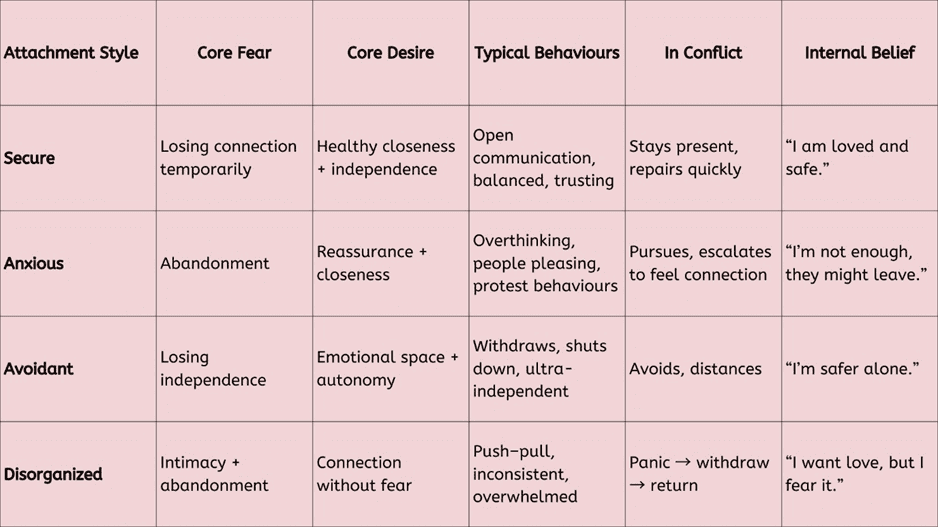
Simple Attachment Style Comparison Chart
Final Encouragement
Attachment is not about blame, it’s about understanding.
It’s about compassion.
It’s about learning a new rhythm of relating.

